Walk into any hardware store and you'll find a wall of battery lawn mowers, every one of them promising more power, longer runtime and a better cut than the one beside it. The specs come thick and fast, volts and amp hours and cutting widths and brushless motors, and almost none of it tells you what the thing will actually be like to push around your own backyard. So most people end up choosing on price, or on whichever brand they half recognise, and then spend the next few years wrestling with a mower that was never really built for their lawn.
It doesn't have to be that complicated. Choosing a battery lawn mower gets much easier once you know which specs genuinely change your experience and which ones are mostly marketing. This guide walks through what actually matters when choosing a battery lawn mower, the specs that count for far less than you'd think, and how to match one to your own backyard, whatever shape it happens to be.
Why Aussies Are Switching to Battery Lawn Mowers
A battery lawn mower is a cordless mower powered by a removable rechargeable battery, with no petrol, no oil, and no starter cord to yank on. You charge it, clip the battery in, press a button, and it runs.
That simplicity is the reason so many households have made the switch. There's no fuel to buy or store, no spark plugs or air filters to service, and no cold-start ritual on a winter morning. They're dramatically quieter, which matters more than most people expect when your neighbours are ten metres away and it's 8am on a Sunday. They're cleaner too, with no exhaust fumes and no petrol smell hanging around the shed. And because there's no engine block, they're almost always lighter than the petrol equivalent, which is the single biggest difference you'll feel in day to day use.
The only honest trade-off is runtime. A battery mower runs until the battery is flat, and on a large block that genuinely matters, so it's worth being upfront about. However, for the vast majority of Australian backyards, a single charge covers the whole lawn with room to spare. And if your lawn does run long, a spare battery clips straight in with nothing to fetch and no waiting, so you're back to mowing in seconds. It's a limit on paper more than one you'll actually notice.

What Actually Matters When Choosing a Battery Lawn Mower
Most buying advice fixates on power figures, but power is almost never what goes wrong. What catches people out is a mower that's too heavy to turn, too wide for the side path, or impossible to get parts for when something wears out. So it pays to run through these six factors first when evaluating a new battery lawn mower:
Weight – Most of the effort in mowing isn't cutting, it's pushing, turning, lifting and manoeuvring around garden beds. A lighter mower changes the whole job, especially if you have a sloped yard, tight corners, or a bad back.
Battery and runtime – What matters isn't the biggest battery available, it's whether one charge comfortably covers your lawn with a bit of margin. Anything beyond that is extra weight and extra cost you're carrying around for nothing.
Cutting width – A wider deck means fewer passes on open ground, but it's harder to steer around obstacles and often won't fit through a side gate. Wider is only faster if your lawn is big and mostly empty.
Ease of use – How simply it starts, how quickly you can change the cutting height, and how it folds down for storage will affect you every single time you mow. These small things decide whether the mower feels like a tool or a chore.
Build quality and spare parts – Ask whether you can still buy a blade, a wheel or a guard in three years' time. A mower you can maintain is a mower you keep, and a mower you can't is landfill the first time something snaps.
Versatility – Some tools handle mowing alone, others also trim and edge, which saves buying and storing separate machines. If shed space is tight, this one quietly matters more than any spec on the box.
Get these right and you sidestep the three things that send a mower to the back of the shed: too heavy to bother with, too wide to fit, and too cheaply made to repair. Everything after that is detail.
A Closer Look at Battery Lawn Mower Specs
Beyond those six factors sits the spec sheet, which speaks a language of its own. A number only means something once you know what's normal, since a figure that sounds impressive on its own is often just average. Voltage, amp hours, runtime, cutting width, cutting heights and weight each have a normal range, so here's what every one of them measures and roughly where it sits on a typical battery mower.
Voltage and Amp Hours
Voltage describes how hard the motor can work and amp hours describe how much charge the battery holds. Most home battery mowers run 18V or 20V at the compact end and 36V to 40V for full-size models, with batteries between 2.0Ah and 6.0Ah. Higher on either measure usually means a heavier battery, and neither figure converts neatly into mowing time, so treat them as background detail rather than a scoreboard.
Real Runtime in Minutes
This is the figure that actually answers your question, and it's the one manufacturers are least keen to print. Expect 20 to 45 minutes from a full charge on most home models, measured in ordinary grass rather than on a test lawn. If a brand advertises volts and amp hours but never quotes minutes, that absence tells you something.
Cutting Width
Cutting width, sometimes called deck size, is the strip of grass cut in a single pass, and it's usually printed in centimetres. Compact mowers sit around 30cm to 34cm, mid-size models around 40cm to 46cm, and anything past 46cm is built for open ground. Check the figure against your narrowest side gate before anything else, since a deck that won't fit through is a problem no amount of power solves.
Cutting Heights
This spec is given as a number of settings and a range in millimetres, typically three to seven settings spanning roughly 20mm to 75mm. More settings genuinely is better here, which makes it one of the few specs where a bigger number is worth paying for. Check how the height is changed too, because a single lever takes seconds and a spanner turns it into a job.
Weight in Kilograms
Weight is the least glamorous figure on the spec sheet, but the one you'll feel every week. A full-size battery mower generally lands between 15kg and 30kg, a petrol equivalent often exceeds 30kg, and compact or handheld-style tools can come in under 10kg. A few kilos either way sounds trivial on paper, but it decides whether you can turn the mower one-handed, lift it over a step, or get up a slope without stopping halfway.

Matching a Battery Lawn Mower to the Size of Your Backyard
Square metres are the easiest thing to measure and the least useful thing on their own. Two lawns of identical size can need completely different mowers, because what slows you down is everything in the way: garden beds to steer around, a slope to push up, a clothesline to duck under, and a side gate that decides what fits through in the first place. Use the table below as a starting point, then adjust for what your yard actually looks like:
| Your yard | Typical size | Cutting width | Runtime you need | What tends to decide it |
|---|---|---|---|---|
| Courtyard or townhouse | Under 100m² | Narrow | 15 to 20 minutes | Tight turns and where it's stored |
| Standard suburban backyard | 100 to 400m² | Narrow to mid | 25 to 40 minutes | Garden beds and side gate access |
| Large block or acreage | 400m²+ | Wide | 45 minutes plus, or a spare battery | Open ground and slope |
The table is a useful guide, but your own backyard should have the final say. Take a look at where you'll need to get the mower, how much you'll need to manoeuvre, and whether there are any slopes or awkward areas to deal with. Those details can change the cutting width, runtime and weight that will work best, even when two lawns are the same size.
The Best Battery Lawn Mower for Your Backyard
Finding a battery mower that ticks every box isn't always easy. One might be light and easy to handle but lack the runtime you need, while another has plenty of power but is bulky, awkward to store or simply too wide for your backyard.
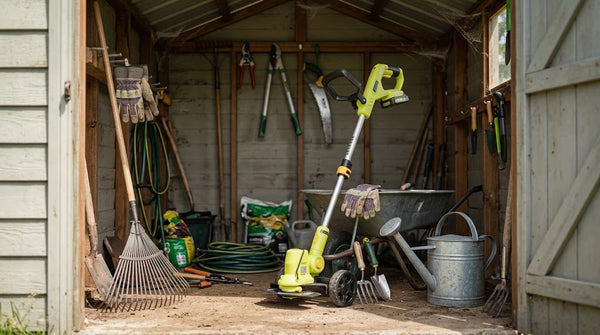
The Lawno is designed to avoid those compromises. It's a 3-in-1 cordless lawn mower, whipper snipper and edger, so one tool handles mowing, trimming and edging instead of three taking up space in the shed. At just 2.3kg with the battery fitted, it's easy to manoeuvre around garden beds and tight spaces, while the 18.4cm cutting width means it can fit through narrow side gates. The adjustable rod extends from 91cm to 130cm too, helping you find a comfortable working height without having to stoop.
It doesn't sacrifice performance for that lighter, more compact design. The brushless 800W motor reaches up to 7,500rpm, while a 20V 2.5Ah EverGreen battery delivers more than 45 minutes of runtime and takes around an hour to recharge. When a component eventually wears out, you can replace it individually, with blades, wheels, guards and flanges all available separately.
On a large, open block, a wider mower will still get through the lawn faster, and that's worth acknowledging. But for small to mid-sized backyards, where getting around the lawn easily matters just as much as raw cutting speed, The Lawno is an ideal option, giving you the freedom to manage your own yard with ease.
Final Thoughts
When it comes to choosing a battery lawn mower, the specifications only tell you part of the story. Weight, runtime, cutting width and build quality all matter, but what matters most is how those things work together in your own backyard. A mower that's perfect for a large, open lawn won't necessarily be the best choice for a smaller yard with tight access, slopes and plenty of obstacles.
Take a few minutes to think about how you'll actually use the mower, then focus on the features that will make that job easier. Look beyond the headline numbers, consider the practical details, and choose something that you'll feel comfortable using every time the grass needs cutting. That's ultimately what makes a good mower. One that fits into your yard and your life, rather than making mowing another chore to put off.